Sunday, 27 January 2013

Say hello to our new Education Officer

New Education Officer, Coral, getting
to grips with one of her new colleagues
Last year we had to say goodbye to our fantastic Education Officer, Amy. She was a real dynamo in our education programme and during her short time here made some outstanding (even award-winning) developments. She'll be sorely missed by everyone here as well as the many teachers with whom she'd built up an excellent relationship. But we're thrilled to announce that one of those very teachers has come to fill her impressive shoes.

So, in her own words, meet Coral Higham...

"A few months ago I was asked to take on the role of Education Officer at Dartmoor Zoo. As a Biologist this was a dream come true. Walking up the driveway with all these magnificent animals just yards away topped any school driveway! I have been visiting Dartmoor Zoo since I was a young girl and can see the magical learning environment it provides. 
I have been teaching in secondary schools in London and Devon for the past 4 years, teaching Biology from preschool to A-Level and A-Level Physics. During that time I have taken on responsibilities for Gifted and Talented, Enrichment and KS2-KS3 transfer. I'm really looking forward to taking the DZP education programme forward along with my very experienced and qualified team of professionals and volunteers in environmental sciences and animal management.
We have a lot planned, beginning with a teacher evening on the 17thJanuary. This free event will highlight our new range of workshops and launch our bespoke lessons which can be tailored to the needs of any school and any subject with the learning delivered here at the education centre or through outreach. 
We are also going to be launching our DZP Rangers programme designed to give children the opportunity to gain valuable experience in animal management, conservation and a host of other subjects in a fun and exciting environment. 
If that's not enough we'll also be building a brand new reptile house, expanding on our award-winning Enterprise Challenge and bringing STEM challenges to the Zoo for families and schools to take part in, to name but a few.

I am so excited about taking on this role. Please don't hesitate to contact me with any ideas you may have, big or small, that we could carry out at DZP for you. This is a truly inspirational place to teach and an exciting learning environment for all ages. I look forward to meeting you all.
For more information on our exciting range of educational activities for everyone, contact Coral and the team today.


Farewell to Ben

Ben the bear 1991 - 2012
It was with great sadness that the zoo lost a big character last year; Ben, our male European Brown Bear, passed away in October at the age of 22. Following extensive consultation with vets he had been diagnosed with an untreatable spinal abscess resulting in paralysis in his back leg. We found ourselves faced with one of those decisions that is straight-forward, yet incredibly difficult to make. He was put to sleep on the morning of 18th of October.

Born in 1991, Ben arrived at Dartmoor Zoo two years later in 1993. He became a well known character and firm favourite with visitors. Before the zoo was taken over, visitors could feed the bears from the viewing area. This created unnatural behaviours such as begging in which the bears would sit up and raise their paws in the air. Once this was stopped and a more suitable and regulated diet of scattered fruits, vegetables, fish and meat was put in place, the begging also stopped. All three of the bears began foraging naturally for their food and managed to shed a few pounds in the process. Despite this change in diet Ben’s favourite meal never changed, it was always a Cornish pasty.

Known to many as a greedy bear, Ben would frequently let the keepers know if they were taking too long to get the food into the enclosure, huffing and grumbling in annoyance. He would always be first out at feed times picking through the meal for his much-loved grapes, as a result he was often seen sleeping off a full belly.

My personal favourite Ben moment occurred when three male members of staff spent three hours of hard graft preparing enrichment by digging a 1.5 metre tube into the ground with spades; the thought was that the bears have to work a bit harder for their food, sniffing it out and reaching into the tube to retrieve it. Ben had other ideas and within 30 seconds had ripped the tube out of the ground and was happily munching on an apple. The look on their faces was priceless.

Ben’s domineering size and personality ensured the other bears were kept on their toes whilst his strength and excellent sense of smell kept keepers on the ball, thinking of novel ways to provide enrichment. He is sorely missed by staff and visitors alike but maybe most of all by the companions he leaves behind, Hayley and Fudge.


Wednesday, 9 January 2013

New Arrivals for Close Encounters


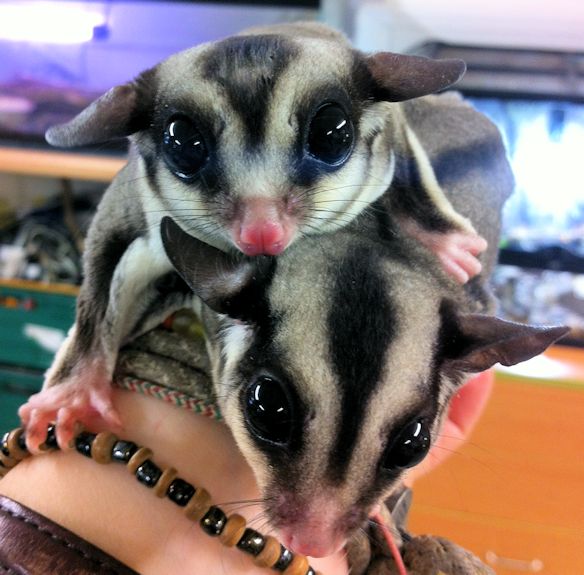
Sugar Gliders, Kyte & Calypso - too cute!
Close encounters at Dartmoor has always been a chance to get up-close and personal with some of our smaller animals and we are happy to introduce you to some of the new arrivals.

Two of our most mysterious additions are Sugar Gliders, Kyte and Calypso.  Sugar Gliders are part of the marsupial group originating from the forests of Australia.  They are nocturnal mammals closely related to possums. Their name comes from their love of sugary foods and their ability to glide distances of up to 150ft from one branch to the next.  Incredibly social in the wild, they can be found in groups of 7 adults plus their young and will be seen grooming each other in small groups.  Sugar Gliders are listed as ‘Least Concern’ under the IUCN Red List, despite the significant decrease of their natural habitat over the past 200 years they have proven to be very adaptable and can survive in small patches of remnant bushes. 

They are fascinating little creatures full of character but they take a lot of looking after. They made their debut with the public recently and were very well received. Needless to say, being this cute they’re already a firm favourite with the staff.

We’ve also added African Pygmy Dormice. As the name suggests they are a small rodent and they’re becoming more and more popular in the domestic pet trade. Also known as micro-squirrel’s these dormice are closely related to rats and mice. No more than 10cm in size, they are colony animals that live in large groups. Their diet consists of a mixture of fresh fruit, nectar and protein – often in the form of mealworm, eggs or crickets.  Here at the zoo we started with a colony of four males and one female, soon after there were two new arrivals, Bounty and Boost, now creating their own colony. 

Dexter - not cute, but very cool!
Our most recent addition, a Florida Soft Shelled Turtle, Dexter, is part of a sad rescue story with a happy ending.  Dexter arrived in a bucket at Endsleigh Garden Centre, Ivybridge, in late November.  Wrapped in a towel, covered in burnt skin pigmentation and suffering with shell distortion as a result of malnutrition and lack of light, he was a particularly unlucky turtle. Florida soft shells are native to the US and found in sand bottom lakes, ponds or slow moving water. They require much more specialist care than other common pet turtles owing to their sensitive shells that, as the name suggests, are soft and covered with skin. They are also highly carnivorous and need a wide range of foods including fish, shellfish, insects and egg.  Dexter was collected from Endsleigh by DZP at the end of December and has settled in well.

One of the largest introductions to our Close Encounter animal collection is Monty, a Flemish Giant Rabbit. Flemish giants originate from Flanders in Belgium. They are believed to have descended from meat and fur breeds of rabbit in the early 16th Century.  These species are a little different to your every day pet rabbit averaging a weight of 16 - 18 lbs. (7-8 Kg) and have been known to reach over 20 lbs (9Kg) and boast an impressive ear size of over 150mm. However, other than their incredible size the rest of their lifestyle is very similar to wild rabbits. Monty lives on a diet of hay, high fibre pellets and the occasional orange root vegetable. He spends his days happily grazing and digging in his new outdoor enclosure in the walkthrough exhibit. 

You can see our Close Encounters collection at regular slots every day at the zoo and many of the animals take part in our outreach programme visiting schools, nurseries and other places.

For more information contact the Presentation Team Supervisor, Emma Baker.

Tuesday, 8 January 2013

New Arrivals

The long awaited and very adorable baby meerkats*
There’s been lots going on at DZP over the past twelve months with new additions to the collection, new babies and lots of developments. Here’s a quick round up of some of the recent highlights.

New Babies!
We've had lots of new babies recently including pygmy goats and lechwe, but the real treat came just be for Christmas in the shape of three adorable baby meerkats.

Sue and Timon are long-standing residents at DZP arriving in the spring of 2010. Though they got on very well together, in all that time we never saw any kits. But with the recent introduction of feisty young female, Xena things got very interesting. She gave birth to two girls and a boy shortly before Christmas.

Sue was always the boss of the troop and, as hoped, Xena took a back seat to let Sue take over the care of the new arrivals. This is quite common among meerkats who are known for sharing the responsibility of bringing up the young.

The arrival of the youngsters brings the total number of meerkats to six. Just a few inches in length, they made their first public appearance in early January. The keepers are working on names at the moment so we'd love to hear your suggestions in the comments below.

Baby Tapir
April saw the arrival of baby tapir, Luta. His name means, "fighter" and you can find out why in this report from Head Keeper, Mike Downman.

Zebra, getting used to their new accommodation
Zebra Development
Over the past few months we have been very busy making preparations to receive three Grant’s Zebra from Longleat Safari Park. Staff and contractors have been working hard through the atrocious weather up-grading the entire perimeter fence and constructing a wonderful curved stable complex that many visitors say resembles an ark. It has three individual stables large enough to provide comfortable accommodation for the zebra as well as our herd of Lechwe Antelope and our two ostrich, providing much needed shelter from the chilly winter months.

This is the largest development we’ve undertaken for quite some time and it would not have been possible without the enthusiastic support of certain members of staff (who literally threw themselves out of a plane to raise money) as well as local businesses, MST Parkins who provided much needed heavy machinery and Tesco who made a generous donation.

The Zebra arrived safely in early December and are currently going through a settling period during which they’ll be kept within the perimeter of the new building. They will be able to enjoy the full run of the main paddock soon, but in the meantime they can still be viewed in the yards from the Jaguar restaurant and play area.

The zebra are a great addition to the collection enhancing a beautiful African vista; a piece of the African plains in rural Devon. Who’d have thought?

You can see more images of the development here and here.

Mongoose Development
In other developments, the old foundation shell of a Victorian greenhouse has lent itself beautifully to becoming the new enclosure for our three mongoose. They have spent most of their time here in an indoor enclosure but this new development gives them a heated house and a large outdoor run.

The house is raised off the ground to avoid the damp with a ramp for access. The walls of the original greenhouse have been retained for their naturally aged beauty but have been modified to contain the animals with a glazed extension. We’ve also provided an outdoor heated area to allow the mongoose to have some fresh air whilst still keeping warm as well as a covered viewing area to provide visitors with shelter from the Devon weather whilst viewing the mongoose through full height glass walls.

Like the zebra development, this project was also made possible by the very generous support of Cornwall Glass & Glazing Ltd who provided all the reinforced glass. There’s a little more work to do but the Mongoose will move in to their new home within a week or so.

Iberian Wolves
Raul and Carlos in their off-show enclosure
Also on the list of “new at the zoo” is the addition of our Iberian Wolves.

To assist with an on-going breeding programme we exchanged our Grey Wolves, Sarah and Parker, with Woburn Safari Park for a trio of Iberian Wolves, Carlos and his younger brothers, Gregorio and Raul (the latter two named with the help of our visitors). Since their arrival they have been housed in our quarantine facility which is an off-show area. This gave us the perfect opportunity to make some major improvements to the old wolf enclosure to welcome our new pack.

The work entailed bringing down several trees with which we were able to build a new “natural” platform to give the wolves a high vantage point as well as shelter. Beside this platform we built an underground den which gives the wolves privacy and also allows us to catch them should the need arise for veterinary treatment or similar interventions. The enclosure containment has also been improved and with the help of Grow for Good South West the entire exhibit has been planted out with meadow flowers to bring a blaze of colour to the site in the spring and summer.

As is often the case with major developments, it has not been easy. Our planned release has been delayed by the severe weather hampering our build and the heavy rains have flooded the den before we were able to complete! So for the time being, they will remain in the off-show holding area which has all the facilities to meet their needs. We plan to have them in their new home very soon. Watch this space!

You can see more images of the wolves and the development, herehere and here.

*Thanks to Steve Haywood for the meerkat photos.

Wednesday, 5 December 2012

High Impact Award for the Second Year Running

Volunteer Sarah with Head Keeper Mike and
Conservation and Research Officer, Adam
The Education Team at Dartmoor Zoo are celebrating again following confirmation that for the second year running they have won the Global Entrepreneurship Week, High Impact Award.

Organised by Youth Business International, Global Entrepreneurship Week celebrates entrepreneurship as a force for good through a wide range of activities.

The "High Impact Badge of Honour" is granted only to those activities which meet a range of criteria demonstrating the contribution the activity makes to the aims of the project.

Since its inception, Global Entrepreneurship Week has spread to 115 countries, with nearly 24,000 organisations planning more than 37,000 activities. In 2011 over 213,000 people attended 2,305 events, run by over 900 organisations as part of Global Entrepreneurship Week in the UK alone.

The award was granted to DZP for their Enterprise Challenge. Launched in 2011, the challenge is a unique activity developed by the education team designed to meet and exceed a range of educational goals in a challenging and engaging manner. It sees small teams of students assuming the role of a Zoo Development Team for an entire day.

"We're very proud of the Enterprise Challenge," explains operations manager, George Hyde. "It involves every department at the zoo from animal care through maintenance to marketing and customer service. It's a real crash-course in the demands of running a modern zoo."

The students' task, often in competition with teams from other schools, is to add a new species to the DZP animal collection. To complete the challenge, students must face and overcome a range of real-world development problems whilst keeping to a strict budget.

At the end of the day-long challenge the teams are required to present their plans to a panel of professional judges comprised of senior zoo management which sometimes includes zoo director, Benjamin Mee.

"The feedback we get from students and staff is amazing," says Benjamin. "We've even run Enterprise Challenge days as team-building exercises for teachers and university lecturers. They find it just as challenging and enjoyable as the kids."

The DZP Enterprise Challenge is just one of a number of major developments within the zoo's education department which have captured the imagination and support of local educators. The new Extended Diploma in Animal Management, delivered in partnership with Bicton College, is now well into its second year with new students already expressing an interest in enrolling next year.

The zoo’s fascinating Dissection Theatre, part of the Dartmoor Hill Pony conservation project, is also now very well established and attracting interest from educational establishments throughout the country.

The Enterprise Challenge is proving particularly popular with secondary school teachers who recognise that it exceeds the specified National Curriculum learning objectives for Economic Well-being and Financial Capability. It also gives higher ability students the opportunity to demonstrate and develop skills in teamwork, assessing needs, understanding risk, finance management and enterprise.

"We've known for quite some time now that the Enterprise Challenge was something special," explains George. "The whole team here have worked really hard to produce something of real value and this award shows that we achieved exactly that."

Educators in the region can see first-hand what the Enterprise Challenge is all about at an open evening at the zoo in January. It’s one of a number of events held throughout the year which provides teachers and youth group workers with an opportunity to see what the DZP Education Team has to offer and assist them in developing further activities.