Showing posts with label bears. Show all posts

Wednesday, 13 February 2013

Happy Birthday to Fudge

Fudge exploring her birthday treats
In January the keepers put on a very special celebration to mark the 35th birthday of a very special resident. Believed to be the oldest of her kind in captivity, Fudge the bear was born in London Zoo on the 15th January 1978.

She was born during Britain’s “Winter of Discontent” presided over by Labour Prime Minister, James Callaghan. When the BBC strikes allowed, the TV schedule at the time included the likes of Mr Benn, Jackanory, The Clangers and Crackerjack. She also shares her birthday with Dr. Martin Luther King, Jr. (1929) and actor Lloyd Bridges (1913).

Fudge arrived at Dartmoor Zoo (then, Dartmoor Wildlife Park) in January 1981. She was later joined by Haley in 1988 and big male, Ben in 1993. Sadly, Ben passed away in 2012. Both Hayley and Fudge have spent the last 25 years together, 20 of those years in their current enclosure. As Bears in the wild only live to around 20 to 25 years at the most in the wild, a 35th birthday is one to celebrate.

To mark the occasion, the keepers prepared a teddy bears’ picnic complete with a bear sized Twister board. Careful consideration is needed when giving animals enrichment, so animal friendly materials were used such as water soluble glue and water based paints to ensure the Bears don’t come to any harm should they decided to eat some of their enrichment.

The enclosure was decorated with brightly painted recycled paper cups strung between the trees to give it a party atmosphere. Cardboard boxes that the keepers bring in from home were covered in wrapping paper and filled with scents such as curry powders and perfumes along with straw to fill them out to act as presents. We provided a piƱata filled with nuts and treats and hung from a tree. As a special treat Hayley and Fudge were given sugar free blackcurrant jelly and a bear-friendly birthday cake which included essential vitamins and minerals, wholemeal flour, eggs and dried blueberries. All the treats were laid out in the enclosure with fresh fish, fruit and vegetables.

All of the animal staff were there to celebrate the big day. Watching the bears push their faces into the presents to cover themselves in the strong smelling scents and eating all the specially prepared food (especially the birthday cake) is a very rewarding part of the job.

The fact that Fudge is the oldest mammal in the zoo and is not the only reason her birthday deserves special attention. Whilst records from London Zoo indicate that she is a European Brown Bear, her physical characteristics suggest that she is actually a Syrian Brown Bear. Staff are working with experts at Plymouth University examining her DNA to establish her true heritage. If this is found to be the case, she will be the oldest bear of her kind in captivity.

Syrian Brown Bears are one of the most endangered sub species, listed as “vulnerable” by the International Union for Conservation of Nature. Whilst they can no longer be found in Syria, a military flight recently spotted some in Iraq via night vision cameras.

Apart from showing signs of arthritis in recent years, Fudge is in excellent health and very active for a lady of advanced years. Even at her age she can be expected to be around for quite a while yet. One famous Syrian bear, Kara from Vienna Zoo, lived to 41 years old.

Hollie Dutton
Keeper


Monday, 11 February 2013

DNA Mystery

Fudge: European or Syrian?
Here at Dartmoor Zoo there are two bears named Hayley and Fudge. It was originally believed that both were European Brown Bears, however there are notable differences between the pair. The most obvious differences, which indicate that Fudge may not be a European Brown Bear are the length of her claws, her overall size and fur colour. As a consequence, despite her records showing otherwise, we have long thought that Fudge is in fact a Syrian Brown Bear.

So, we decided to turn to scientists at Plymouth University for a definitive answer.

We contacted several zoos around Europe to find a collection willing to send hair follicles from a true Syrian Bear to compare to our own. Heidelberg Zoo in Germany kindly sent a sample of hair from a Syrian Brown Bear in their collection. We also took samples from our own bears, a process which thanks to their training was stress free for all concerned.

Dr Mairi Knight of Plymouth University’s School of Biomedical and Biological Sciences is currently working with the samples. At this point, it’s important to point out to all readers familiar with CSI that DNA sampling isn’t a straightforward case of shaking liquids about in test tubes.

The first step is to extract DNA from all the samples. Whilst extracting DNA from hair is now routine in many laboratories, since there is not much DNA contained in hair (the main source being from the follicle cells in the root) yields of usable material can be very small. To get at the DNA the scientist will digest the cells using particular enzymes to free up the DNA, and then carefully remove the other cellular material by a process of ‘chemical washing’ to leave a clean solution of just DNA. In mammal hair often colour pigments can inhibit part of the later processing and so care needs to be taken to ensure that these are also removed.

Once the DNA material has been isolated, a technique called ‘PCR’ (Polymerase Chain Reaction) is then used to amplify a small section of DNA into enough copies for analysis.

This final step involves using a Genetic Analyser which highlights the particular strands of interest. DNA sections or ‘regions’ that are known to be particularly useful for tracing the ancestry of a species will then be screened. The exact sequence of DNA from Fudge and the comparison brown bear samples can then be analysed for similarities and differences, allowing Fudge’s most likely ancestry to be determined.

There are many subspecies of the Brown Bear, which have adapted to different habitats making the specie as a whole more diverse. Brown Bears are distinguished from others by their shoulder hump, the consequence muscles specially adapted for digging. They have the widest distribution of any of the bears and can be found in Europe, Japan, North Asia and other places. Subspecies of the Brown Bear include the Alaskan, Asiatic and European Brown Bear, as well as the Grizzly Bear, Himalayan Snow Bear, Kodiak Bear and the Syrian Bear.

European Brown Bears have small, round ears and have brown fur ranging from yellow to dark brown. They can be found in Northern Europe and Russia and are the most widely distributed subspecies of bear.

Syrian Bears are the smallest subspecies of Brown Bear and the only Bear known to have long white claws. Their fur is very light brown while the fur on the shoulders has a darker grey base. Also, on some Bears there is a dark stripe running down the back.

Syrian Bears are found generally in the mountainous areas in Iran, Iraq, Turkey and the former Soviet Union, however due to habitat loss and poaching, the population is in decline. They can no longer be found in Syria.

Fudge is a very special part of the DZP collection. If our suspicions are confirmed, she will be the oldest of her kind in captivity (she recently celebrated her 35th birthday). However, the search for a definitive answer to the question of Fudge’s origins is a lengthy and complex process and there’s even the possibility that the results will raise more questions. There are some within the scientific community that believe, despite the obvious physical differences between what we term to be European and Syrian Brown Bears, that at a genetic level there is a case for declaring no difference at all.

We’re very much looking forward to seeing where our investigations will take us.

Hollie Dutton
Keeper


Sunday, 27 December 2009

Boxing Day Photos

I did create a lovely slideshow for this but have experienced the usual technical problems with blogger! Anyway, as you can see our animals enjoyed their festive enrichment.


Friday, 21 August 2009

Fire hose fun for Sovereign

Thanks to another large donation of fire hose from the fire brigade this week, the keepers have been very busy creating a variety of enrichment devices. Fire hose is used by lots of zoos, it is incredably durable and therefore safe to use with even the most destructive of our animals.


Sovereign, our ten year old male jaguar, was one of the first to benefit from the delivery. We decided to make a sling for a large boomer ball and to hang this up from a tree in his enclosure. Boomer balls are a firm favourite with the carnivores but by suspending one up high, the type of movement possible would obviously be very different. It was made so that peices of meat could be wedged between the straps and the ball, making food acquisition much more of a challenge! After a week or two, the object will be removed and hung in one of our other cat enclosures for a short time so that Sovereign doesn't become bored with it. The scent of other felines on the ball as it is rotated around the enclosures can only add interest.


Fire hose was also randomly woven between the other trees in the jaguar enclosure and loose ends left hanging down. We hope Sovereign will perhaps bat and pull on these, and we can also suspend food from them.


Our curator Will has made this browse holder and we will be making more in the near future. These will be given to many species including the vervet monkeys, coati, tapir and reindeer. We have plenty of other ideas for the fire hose including a hammock for the bears.


Sunday, 2 August 2009

Animals Asia

For just over a year we have been supporting an animal charity called Animals Asia by collecting money here at the zoo.
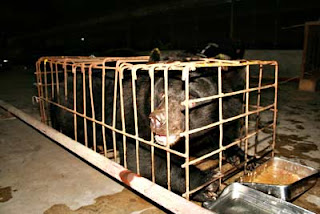
Animals Asia is a Hong Kong based charity who are devoted to the needs of wild, domesticated and endangered species throughout the Asian continent. One of their campaigns is called the 'moon bear rescue'. In countries across Asia, thousands of bears live a life of torture on bear farms, so that bile can be extracted and used in traditional medicine to cure ailments ranging from headache's to haemorrhoid's. Bears are confined in cages which vary from agonisingly tiny crush cages to larger pens, all of which cause terrible physical and mental suffering.

Animals Asia go to these farms and document what is happening and try to get these farms shut down. The bears are then taken to their rehabilitation centre where they begin the long journey of getting better. Some never make it as they are too ill and are put down, but the staff at the centre do their best and alot grow healthier by the day and spend the rest of their lives at the Animals Asia Sanctuary. These bears could never be released into the wild again as they have had too much human contact and some are missing limbs.

We chose this charity as although we don't have Asiatic black bears at the zoo we do have European brown bears and thought it would be a worthy cause. Unfortunately on Friday we came to empty our Animals Asia collection pot which is situated by our bears and found that someone had stolen it. This upset the staff alot, as we have so far raised nearly £1500 for Animals Asia, and were hoping that we would increase the amount over the summer holiday.

Anyone with any information about the theft should contact Dartmoor Zoo.


Thursday, 2 July 2009

Feeling Hot, Hot, Hot!

As it has been so hot over the past few days we have been thinking of ways to keep our animals cool.
A favourite with most of them is frozen fruit. We either freeze fruit such as melons, pineapples, apples and pear or blend up the fruit, mixing it with water and freezing it so it ends up like a fruit ice lolly.


The bears have a moat with water in and we often see them going for a paddle on hot days. To add to their enjoyment we throw some of the frozen fruit into the water so they have to fish about for it.


For some of our omnivores, such as the meerkat and mongoose, we freeze bugs into ice cubes which they really enjoy. It takes them a while to lick through the ice before getting to the treat inside.

The cats love blood bergs which we give them occasionally. These consist of blood or bits of meat mixed in with water which is then frozen. Sometimes when the weather is really hot the tigers decide to go for a swim in their moat. As tigers love water it is ideal for them to have this in their enclosure. An alternative to the moat is when we squirt water with the hose into their enclosure. The tigers start playing around with the jets of water, chasing after it and trying to bite the water.